Insulation gets compared on one number, and it is the wrong number to lead with. R-value tells you how well a material resists heat flow in a laboratory. It tells you nothing about air moving through the wall, nothing about what happens to moisture that gets in, and nothing about whether the assembly can dry out afterwards. In North Carolina, those three things decide how a wall performs and how long it lasts.
The problem this climate actually presents
Our summers are hot and humid for months at a time. Inside, the air conditioning is running and the interior surfaces are cool. That combination drives moisture inward through the wall, which is the opposite of the direction most people picture.
In winter the drive reverses and moisture moves from the warm inside toward the cold outside. So a wall here has to handle vapour arriving from both directions, in different seasons. An assembly designed to stop moisture in one direction only will trap it going the other way, and trapped moisture in framing is how a house rots from the inside without anyone seeing it.
What each material is actually good at
Closed cell spray foam is an air barrier and a vapour retarder as well as insulation, in one application. It achieves a high R-value per inch, which matters when the cavity is shallow. It adds rigidity. In the right place, such as a rim joist or an awkward geometry that is hard to seal any other way, it is genuinely the right answer.
Its weakness is the flip side of its strength. Because it is close to vapour closed, a wall insulated with closed cell foam dries poorly. Water that gets in from a flashing failure or a roof leak has no easy route out, and it sits against the framing. The foam also bonds to everything it touches, so opening a wall later, to find a leak or to renovate, is destructive.
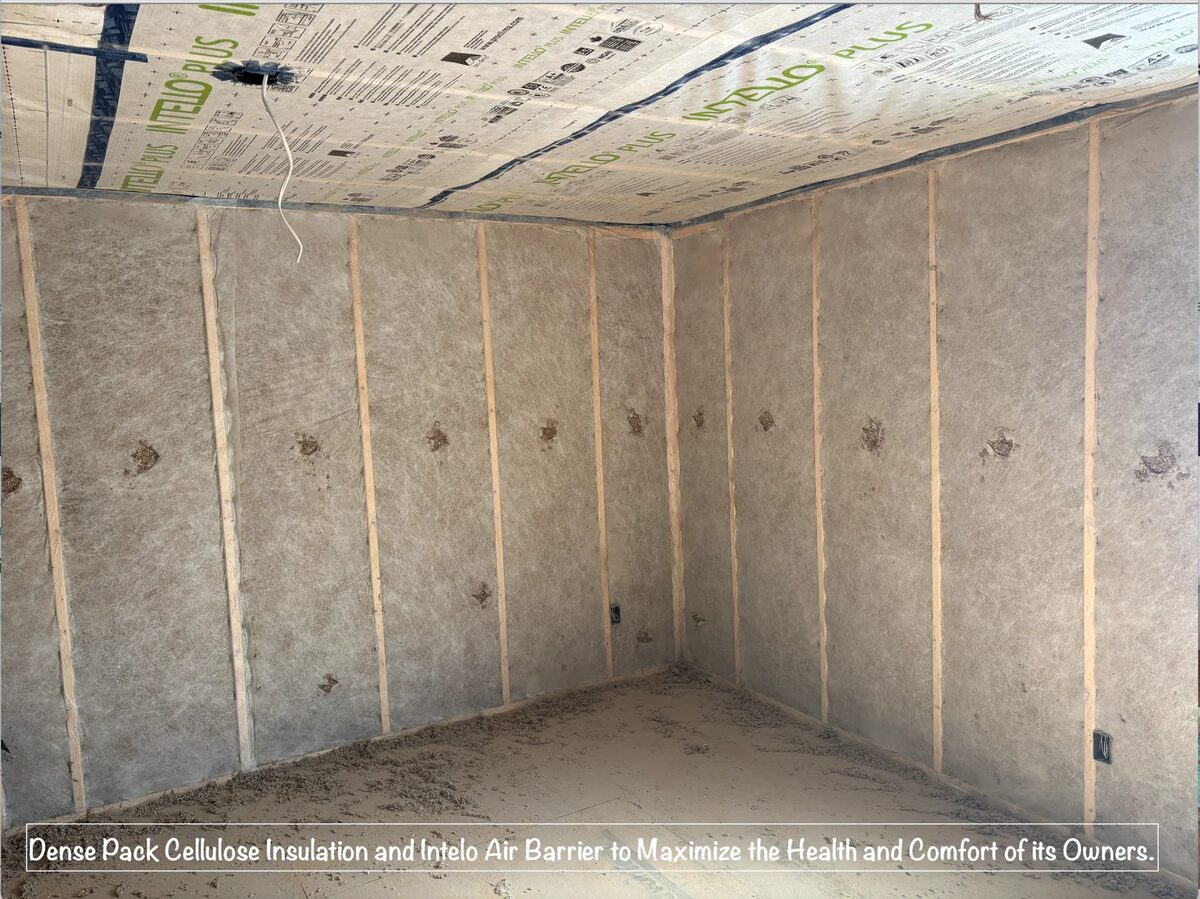
Dense-pack cellulose is recycled paper fibre blown into the cavity under pressure until it will take no more. It is vapour open, so the wall can dry in either direction. It handles small amounts of moisture and releases them rather than holding them against the wood. Packed to proper density it does not settle, which matters because insulation that settles leaves a cold void at the top of the wall a few years in. It is also a noticeably better sound absorber than fibreglass, which people tend to notice more in daily life than they expect to.
Cellulose is not an air barrier. That is the key point, and it is why the material choice is only half the conversation.
Air sealing is the part that matters most
An uncontrolled air leak beats the best insulation on the market. Air carries far more moisture through an assembly than vapour diffusion does, and it carries heat with it. A wall packed with excellent insulation and full of unsealed penetrations will underperform a modest wall that was sealed properly.
This is why the sequence matters more than the product. Every penetration gets sealed while it is still reachable, before insulation, before drywall. Once the wall is closed, nobody is going back in.
Spray foam gets chosen partly because it does the air sealing and the insulating in one step, which is a real advantage on a job where the sealing would otherwise be rushed. The alternative is to treat air sealing as its own deliberate stage, which is what we do.
Letting the wall dry in both directions
The assembly we use when an owner wants to go further pairs dense-pack cellulose with a variable permeability membrane on the inside face. The membrane tightens when humidity is low, keeping moisture out of the framing in winter, and opens when humidity is high, so anything that did get in can dry back to the inside in summer. A plain polyethylene sheet only ever works in one direction, and in this climate that is the wrong tool.
Outside the sheathing, a continuous layer of exterior insulation keeps the studs from acting as thermal bridges. Without it, every stud in the wall carries heat straight through the insulation you paid for, and the framing runs colder, which is exactly where you do not want condensation.
You can see this assembly drawn and described in detail on How We Build.
Being straight about where this belongs
This level of envelope is not standard on every house we build, and we would not claim otherwise. Solterra Way is the full version of it, built for an owner who wanted it and was prepared to pay for it, and it ended up on the High Performance Home Tour. Most projects land somewhere below that.
What is standard for us is the part that costs relatively little and matters disproportionately: air and bug sealing as normal practice, penetrations detailed by hand before the walls close, and mechanical decisions made with running costs in mind. You can build a good, durable, comfortable house without every item on the list. What you cannot do is skip the air sealing and make up for it later.
So which one
Where the cavity is shallow, the geometry is complex or the location genuinely needs a vapour retarder, closed cell foam earns its place. For a standard framed wall in this climate, we would rather have dense-pack cellulose behind a deliberate air barrier and a membrane that lets the wall dry both ways, because the failure mode is far more forgiving. A wall that can dry survives the leak it eventually gets.
If you are early enough in a project that the wall assembly is still an open question, that is the right time to talk about it. Tell us what you are planning and we will give you a straight answer about how far yours should go.
Written by the team at NG Custom Builders, a licensed general contractor in Raleigh, North Carolina.